IPO Filings: NorthStar Earth & Space Resale Filing Goes Effective
NorthStar Earth & Space's F-1 resale registration went effective on Nov. 9, covering 28.1 million shares. What the IPO filings show on sellers and warrants.
Key takeaways
- The SEC declared effective on Nov. 9 the Form F-1 of NorthStar Earth & Space Enterprises, Inc. (NSTR), one of the IPO filings that lets holders of shares from its SPAC merger sell into the market.
- The registration covers 28,146,709 common shares and 219,998 warrants offered by selling securityholders, not by the company.
- NorthStar receives no proceeds from those sales, but could receive up to $25,529,977 if all of its warrants were exercised for cash.
- The prospectus lists the shares and warrants on NYSE American as NSTR and NSTR.WS.
What this registration is, and is not
An F-1 normally brings to mind a foreign company’s IPO. This one is different. NorthStar’s filing is a resale registration: it registers securities that already exist so their holders can sell them under the registration rights agreement the company signed as part of its going-public transaction.
NorthStar, a Montreal-based provider of space situational awareness data, became public through a merger with Viking Acquisition Corp. I, a blank-check company sponsored by KingsRock Advisors. The company has said it tracks satellites, debris and other objects in orbit to help operators reduce collision risk. Because the merger has closed, this registration adds no new shares to the market from the company itself. It changes which existing shares can be sold freely.
Who the sellers are
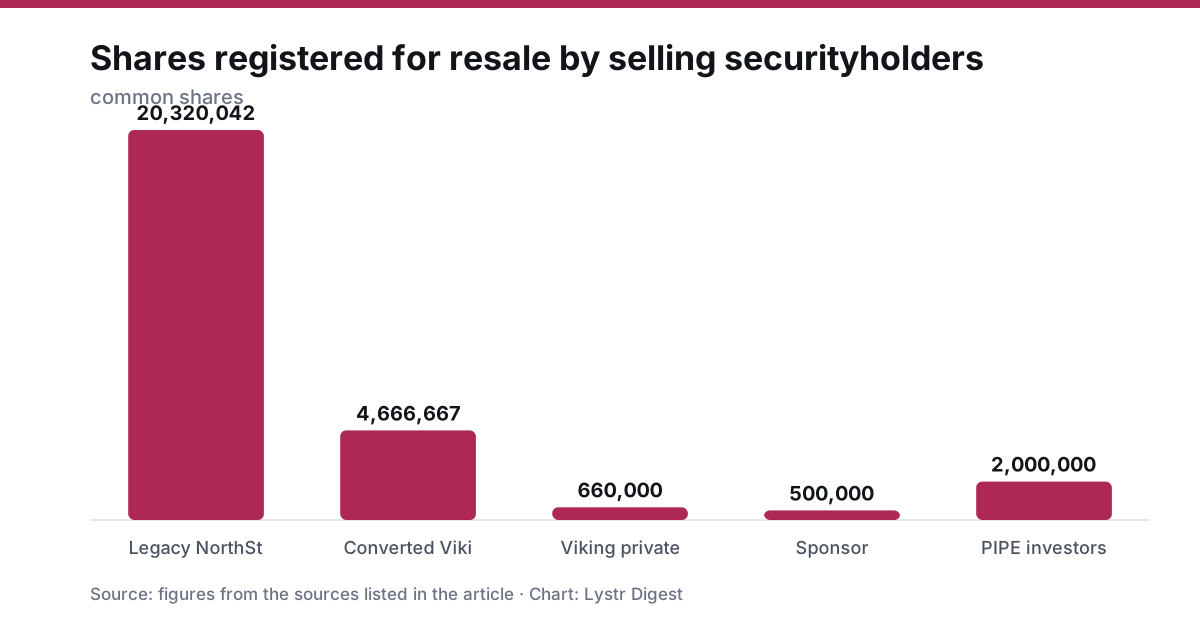
The 28,146,709 shares fall into five groups.
| Holder group | Common shares |
|---|---|
| Issued to Legacy NorthStar holders | 20,320,042 |
| From converted Viking Class B shares | 4,666,667 |
| Viking private placement | 660,000 |
| Sponsor | 500,000 |
| Transferred to PIPE investors | 2,000,000 |
| Total | 28,146,709 |
The prospectus also registers 219,998 warrants for resale and the 2,219,998 common shares issuable on warrant exercise. If every warrant were exercised for cash, the company would receive up to $25,529,977, a figure that implies an $11.50 exercise price.
One line in the table needs explanation. The 2,000,000 shares “transferred to PIPE investors” are shares the sponsor side passed to investors who bought into the private placement that accompanied the merger, and they are registered here so those investors can sell them. The 4,666,667 shares from converted Viking Class B stock are the former founder shares of the blank-check company.
Reading the prices
The prospectus references October 29 closing prices of $3.54 for the common shares and $0.15 for the warrants. A warrant struck at $11.50 against a share price near $3.54 is far out of the money, so cash exercise is not a near-term prospect at those levels. The $25.5 million figure is a ceiling that depends on a much higher share price.
Why resale filings matter on an IPO calendar
Readers who follow upcoming IPOs and new listings often skip resale registrations because they do not raise capital. They matter for supply. After a SPAC merger, a large block of shares sits with sponsors, PIPE investors and legacy owners who cannot sell until a registration statement is effective or an exemption applies. Effectiveness removes that barrier, subject to any lock-up terms in the underlying agreements.
Here, the registered amount, about 28.1 million shares, is the pool that can now be offered by holders.
The company is an emerging growth company, and in its pre-closing disclosures it described itself as early-stage with a history of losses, which is typical for companies that reach the market through a SPAC and one reason resale supply is watched closely.
What to watch
- Any supplements to the prospectus that name additional sellers or update share counts.
- Trading volume in NSTR after effectiveness.
- Whether the company discloses further financing, since it receives nothing from the resale itself.
This article reports on public filings and is not investment advice.
Prepared with AI assistance from public sources and reviewed under our editorial policy. Not investment advice.